In June, we stood in front of 60 to 70 GCs and legal ops leaders in London at the Our Legal Community AI certification course. On Monday this week, we ran the second iteration in Silicon Valley in front of a room of about 100 to 120.
The headline from London was: Agents are ready. Find the right workflow, hand it to an agent, and take some of the load off your legal team.
By the time we took the stage at Silicon Valley, that message was already out of date.
Note: for those who don’t know, OLC is the community Colin McCarthy and Anne Graue built for in-house legal teams. The AI certificaion course is designed to get in-house teams ready to deploy AI in a way that actually changes their legal work.
Agents are old news
In June 2026, rolling out an "agent" was still a project. You had to scope a workflow, pick a tool, configure it, test it, and etc.
By November 2026, an agent is a sentence in a chat window. Type "go ahead, use your discretion" into Claude, and away it goes. Once you are happy, schedule it to run every Monday morning.
The consumer market has moved even further. Meta launched Muse on 8 September, which is designed to be proactive rather than wait for a prompt. Three weeks later, OpenAI released dots, always-on agents that looks for work to do. The consumer market is treating agents as solved (though, not yet widely adopted).
From "could we" to "should we"
The teams that have deployed agents are already asking a different question. Not "can we use an agent?" but "should we?"
We think that is a healthy shift — choosing the right workflows is how we find ROI. Every agent or AI workflow costs something — someone has to build it, supervise it, check its output, and keep it current.
So the real question is one of resource allocation. Is this AI agent impacting our productivity? Or, are we automating work that never mattered in the first place?
The frontier for DIY
The frontier has moved to custom tools. Lawyers and legal ops people are vibe coding solutions in a chat window: a clause tracker, a matter dashboard, a triage form for the business, etc. Things that used to need a willing vendor, a budget line, or a six-month implementation now take an afternoon on Claude.
One way to illustrate the shift is a 2x2 competency matrix:
The x-axis is how general or specific the tool is.
The y-axis is how basic or advanced the use is.
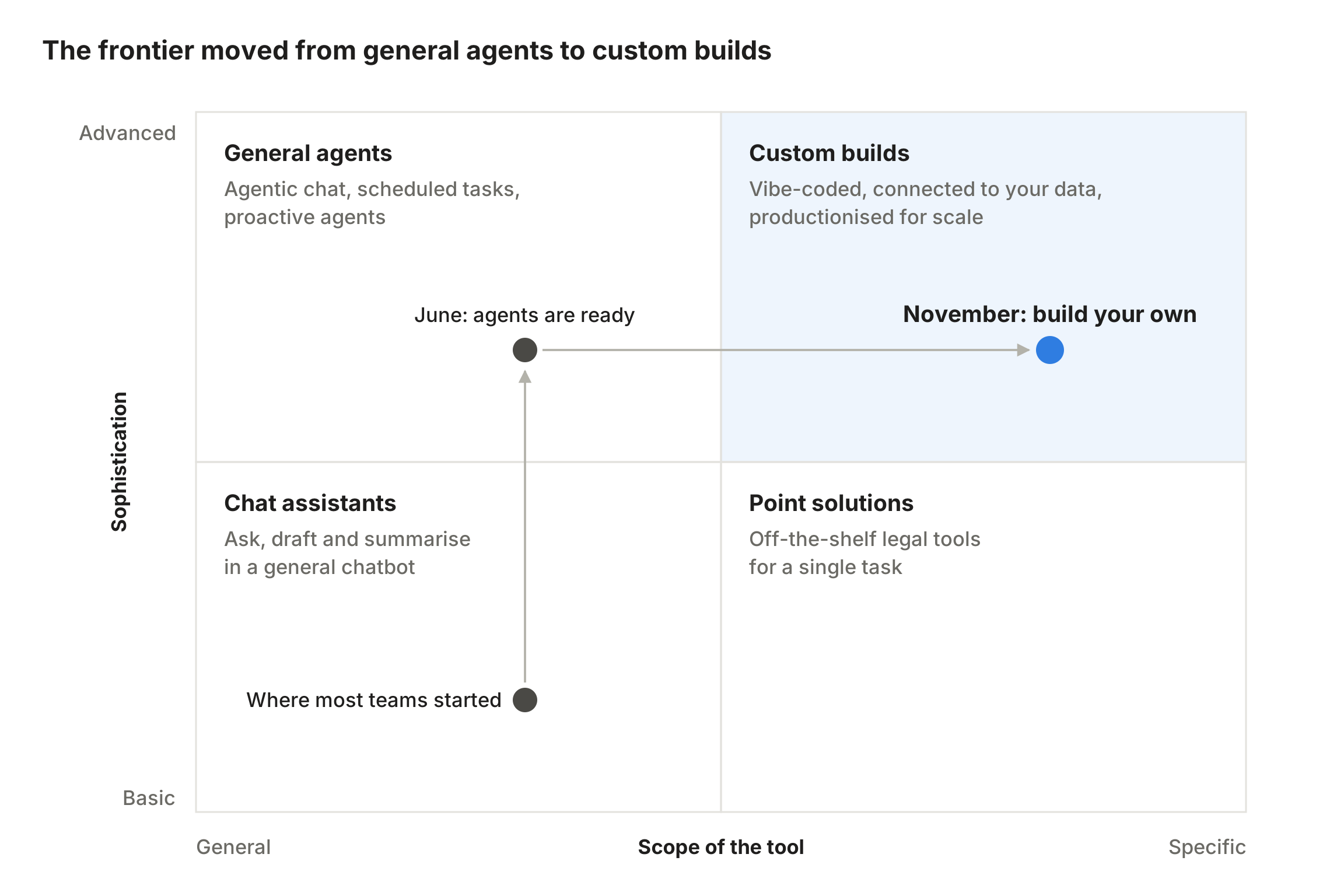
In June, the message was to move up, from chat assistants to general agents. In November, the frontier moved right, to highly customised tools that do one job, built around one team's way of working.
The last mile
Vibe coding creates a working prototype. Once you have one, only two things are left:
Connect it to a data source. A tool that can't see your contract repository, your policy library or your matter system is a demo. The answers have to come from your documents.
Productionise it. Make it secure, permissioned and logged. Make it survive a hundred users instead of one. Make sure someone owns it when it breaks at 9pm.
It's the same conclusion we reached in There are only two things left to build. The first 90% is now free. The value sits in the skills and the data, not in the code.
Some teams in the room are ready for that last mile: they have an IT partner who answers their emails, and data they can actually reach. Some are not, and their prototypes will stay prototypes. That gap, not access to agents, is what will further separate in-house teams in 2027.
Where it counts
If June's lesson was "agents are ready", November's is "so what are you improving?"
Building is no longer the bottleneck, choosing is.
One use case that came up a few times in Silicon Valley was intake: tools that let the business ask its legal questions directly, with a target of stopping 80% of queries from ever reaching the legal team. It's a good example of the frontier in practice. It's specific to one team's playbook, it only works if it's connected to that team's documents, and it has to be production-grade because the business is using it, not just the lawyers.
It also has consequences well beyond the legal department. In our next post, we will play out what happens to law firms if an automated in-house intake actually works.
Given how fast things moved since June, I suspect that by the next OLC course, this blog post will sound like ancient history.